It's back to square one after a long journey in Southeast Asia. A boundless journey which I embarked on all alone. A journey, the rewards of which cannot be measured in monetary terms. A journey, the experiences from which will stay with me for a life time. A journey, which has shaped me into a better person today.

I was traveling in Southeast Asia's Indochina region. Indochina is another name for mainland Southeast Asia, which comprises of Myanmar (Burma), Thailand, Laos, Cambodia, Vietnam and peninsular Malaysia.
I planned this trip while the world was deep in one of the worst recessions since the Great Depression of 1930s. I looked at the map of Southeast Asia and simply pointed at the places that I've always wanted to visit. Only my air tickets to Bangkok and out of Hanoi were booked in advance. This gave me the maximum flexibility to travel as I wished in the region. My original plan changed considerably once I was on the road.
The trip was funded entirely by my 2008 income tax refund. Excluding the airfare to the region, it is not very expensive to travel in Southeast Asia. My average spending over six weeks was less than US$20/day (or Rs.1000/day), including accommodation, food and transportation.
A common question for locals and other travelers to ask when you're traveling is 'where are you from?’ This seemingly simple question is not as straightforward as it sounds. For many people, 'where are you from?' is not the same as 'where do you live?’ I found that this is particularly true with Europeans, but not so with Americans and Canadians. Depending on whom I was speaking to, I mostly said India, and if the conversation went further, then the part of me living in Canada was revealed.
When I was in Southeast Asia I was the self-declared Brand Ambassador of India. I think I did a good job as most people appeared to like me. I was quite the celebrity in Southeast Asia as many people wanted to get their pictures taken with me or just talk to me! I want people in the countries that I visit to think of me whenever they think of Indian people. This is relatively easy to do because, except for Thailand and peninsular Malaysia, not many Indian people visit the Indochina region.
I was affectionately called "Mr. India" in Laos by the locals and a taxi driver in Myanmar asked me where I was from and said he was very happy to see me after having refused a ride from him. In Vietnam, the owner of a hotel in which I was staying invited me for lunch with her family who treated me like I was a part of their family. Little things like these made a good trip even better. I tried to learn, at least, how to say 'hello', 'how are you' and 'thank you' in their language; be polite to everyone; have a winning smile; not litter etc. All of these things, collectively, helped retain goodwill for me among others and will hopefully retain a lasting good impression on Indians, in general, in their minds.
Speaking of lasting impressions, I still remember a Ukrainian couple that I traveled with for a few days in Myanmar. They had purchased a bottle of wine for around US$1.00 and it was kept unsecured and in the open while in a long-distance overnight bus. Not surprisingly, the bottle was missing by the time we reached our destination in the morning. The guy took out his anger on the poor manager of our guesthouse by arrogantly cursing and calling all Burmese thieves. I'm sure his remarks must have left a bad impression on Ukrainians in his mind and others, including myself, who heard his abuses. Because really, when you're in a foreign country, you're representing the country of your origin and naturally become its ambassador - whether you're up for the task or not.
Thailand: Land of Smiles
Landing in Bangkok, the City of Angels, all alone at midnight is no smiling matter. I took a taxi around thirty minutes past midnight to Saphan Khwai. The taxi driver over-charged me; I hadn't been in Thailand for more than an hour and I was already ripped off! Not a good start to my trip, but I brushed off the incident as 'part of the traveling package'. Taxi drivers are notorious over-chargers any where.

Most visitors to Bangkok make a beeline for the Khao San road - a haven for backpackers. For some reason I chose to stay in Saphan Khwai. I stayed here for three nights even though it was a bit pricey. For the last two nights I moved to Khao San road and wondered that if this is how it is the low season in the middle of a recession, then what must this place look like in the high season? I had never seen so many foreigners (Westerners) in my life before - almost all of them armed with a copy of the "Lonely Planet" guide! The place was crowded and there were more Westerners (backpackers) here than Thais, and more Thai prostitutes than other Thais. I felt more out of place here than I did in Saphan Khwai, a Thai, non-touristy neighbourhood. It was absolutely crazy. Love it or hate it, one cannot ignore the Khao San area - it is an experience in itself.
Khao San road is a place where the party goes on all night. It is a place with many bars and clubs whose patrons are all foreigners and where Thai prostitutes make a good living. Since the Khao San area is not connected to the Skytrain or the subway, it is difficult to venture out of this area without hiring an expensive taxi. Most people come here to party and are not too keen on venturing out anyway.
I am happy I did not stay in Khao San the entire time. I loved Saphan Khwai as it was connected by the Skytrain, which I thought was one of the coolest ways of getting around in Bangkok. The only reason I moved to Khao San was because I had met a few people at the embassy of the Union of Myanmar, who were staying in that area. We had decided to fly together for an exciting adventure in the mysterious and unknown Myanmar.
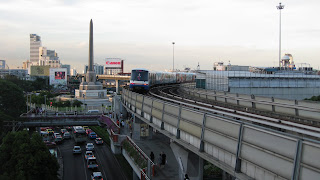
Walking around in Bangkok, it is not difficult to see that their economy is heavily dependant on tourism. Thailand gets over one million visitors every month. It is also one of the most tourist friendly countries I've ever been to. It makes absolutely no sense to be a package tourist here as it is very easy to arrange things on your own.
I did a bit of sightseeing in Bangkok, but my main aim of coming to Thailand was to secure a visa to Myanmar, which I did with relative ease. See A Day in Bangkok for more on the City of Angels.
Golden Land of Myanmar (Burma)
A wise person once said that "to travel is to discover that everyone is wrong about other countries." I found that this is especially true in case of Myanmar.
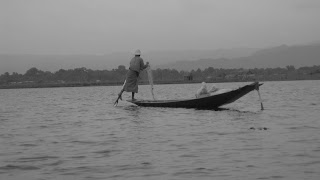
The Union of Myanmar is the largest country in the Indochina region and is governed by an oppressive military junta (supported by China). It also has the dubious distinction of being the most corrupt nation in Southeast Asia.
The government of Myanmar and the people of Myanmar can be thought of as two separate entities. The government can be described as corrupt-to-the-bone and oblivious to the needs of its citizens. These facts are sufficiently confirmed after spending some time in the country and talking to the local people.
The people of Myanmar, on the other hand, are very simple and deeply religious. It is a predominantly Buddhist nation with a sizable Muslim minority and smaller Hindu and Christian communities.

Despite what one might hear in the media, Myanmar is a safe place to travel to. There is almost no crime, even in big cities. Why would there be when the disparity between the "haves" and "have nots" is negligible? When everyone is poor, there is no motivation to commit crimes. The only rich people are the all-too-powerful government officials who literally live in fortress-like homes. In fact, in 2005, the government changed its capital from Yangon (Rangoon) to Naypyidaw, which is a city built specially for all the government officials, away from everyone else. Naypyidaw is about 320km north of Yangon.
Myanmar is not a country to go to without conducting some research beforehand. For example, there are no ATMs or traveler's cheque cashing facilities. Credit cards cannot be used either. All visitors to this country need to bring enough US dollars with them to last the duration of their stay. This could be $500-1000 per person for a month's stay. Everyone in Myanmar must know that tourists carry a lot of cash on them. Still, I never felt unsafe in the country - even while walking alone at night in Yangon. A tourist being robbed is almost unheard of in a country where foreigners are practically revered.
Another interesting thing about Myanmar is that it is better to convert US dollars to the local currency in the black market, rather than in the official market (e.g. airport or bank). The official rate is US$1.00 = ~6.50 Kyats. The black market rate in June 2009 was US$1.00 = 1,080 Kyats. What a significant difference! This is another reason why it pays to do research before coming to this country.

During my entire trip, I did not see a single person defecate or urinate in the open. Basic toilets are found everywhere. That's how it should be everywhere. See this post for more on my observations, facts and tidbits on Myanmar.
I did not meet a single person who was happy with the government (junta). So who is supporting the government? China. Why? The governments of both China and Myanmar have partnered up to exploit Myanmar's natural resources. Electricity from dams built in Myanmar goes to China (and Thailand); none of it goes to Myanmar! The government of Myanmar is also over-exploiting its forests at an alarming rate for the benefit of Chinese firms (who need timber to make furniture that is shipped to the Western world).

How else is the government making money? By controlling the production of opium. There are many regional contenders for this, who often fight with the government for its control. This is the reason why many of Myanmar's bordering regions are out-of-bounds for foreign travelers - they are just too dangerous. Opium from Myanmar is exported to all over the world.
I was lucky to have the company of people from various walks of life while traveling in Myanmar. JJ, an American, was a former drug dealer and an ex-con. He was the son of a retired millionaire merchant ship captain and was planning to spend 6 months in Southeast Asia (or until his US$6,000 run out). It was always interesting to talk to him about world politics and religion. He was very intelligent and held a Masters in Education degree. AG, a British guy, was a "shop fitter" in the UK, and nobody knew what that meant. He had taken a break from work and had been traveling for 7 months. His previous work experience included working in a beef processing factory where his job was to mop blood off the floor and to lift cut-off heads of cows with his bare hands. He shared many fascinating stories from his work with us. IZ and JT were friends of AG, and both were French. IZ had worked in an import/export company and JT was a "social worker" (not sure what exactly she did). Both were best friends, had quit their jobs, and planned on traveling for 2 years. In our routine life we only tend to meet people who are, more or less, like us and do similar things as us. So, it was very interesting for me to travel with such a group. A lesson I've learnt is: not to judge a book by its cover.

To me, Myanmar is a country of monks. I've never seen more monks anywhere else in the world. It was fascinating to see the early morning ritual of small groups of monks walking in a line to collect alms from the villagers. The monk at the front of the line used a bell to alert people of their arrival. When the monks arrive, the lady of the house, who is waiting for them, takes off her footwear and puts food (usually some rice and curry) in a basket carried by each of the monks as they come to her in an orderly fashion.

I consider myself blessed to have seen the age old Buddhist tradition of this wonderful country.
Lao People's Democratic Republic or Lao PDR (also known as Laos)
Among the Southeast Asian capital cities, I've seen Yangon (Myanmar), Bangkok (Thailand), Phnom Penh (Cambodia), Hanoi (Vietnam) and Vientiane (Laos). By far, Vientiane has to be the quietest capital city in Southeast Asia. Situated along the banks of the mighty Mekong river, the city is small, traffic is light and the atmosphere is laid back. I spent about four days here just taking it easy.
My most memorable experience in Vientiane was when I went to visit Wat Sisaket, the oldest temple in the city (built in 1818 AD). While strolling in the temple grounds, I was asked by a monk, who was with two of his friends, if I would chat with them for a while. They wanted to practice speaking in English. So we walked to the monastery and sat on the floor of their room. It immediately started raining heavily. The rain lasted for two hours and I ended up talking to them for that long - much longer than I had anticipated.

I learned quite a few things about their daily routine, their culture and the history of the temple and of Laos. A monk named Khamdy did most of the talking; the other two who were novices did not speak much English. Monks start off as a 'novice' before attaining the status of a 'monk', which takes about two years. Monks have to adhere to a much longer list of "restrictions" than novices. Their first meal is early in the morning and lunch is normally the last meal the monks and novices get to eat; after that they're only allowed to drink water.
Khamdy does not want to be a monk for ever. He said he hopes to finish his "monk education" at the temple and, if his parents help him out, he would like to attend university to get a bachelor's degree in English. He wants to be an English teacher. I think he will be an excellent teacher. He has added me on Facebook and still keeps in touch via e-mail (to practice his written English).
He said monk education, which concentrates on the teachings of Buddha, is good if one wishes to be a monk forever. However, this education is of little or no value in today's modern and highly competitive world.
Because of our preconceived notions on monks, it was always amusing to see them talking on their cell phones (Thailand), smoking cigarettes (Thailand), chewing tobacco/betel (Myanmar), browsing through the latest music and movie CDs/DVDs (Myanmar), listening to music on their iPods (Thailand and Laos) or even checking out toy guns (Myanmar). While it is easy for us to be critical and make jokes of what they do, let us not forget that they are people too with likes, dislikes and habits just like us.
It is also important to note that many monks, particularly in Myanmar, become monks not because that's their life's calling, but because there is no other alternative. Myanmar's education system is in shambles. Therefore, it is better to send your children to a monastery where they will be provided with food and shelter, and learn the teachings of Buddha along with discipline.
I was looking forward to going to Luang Prabang, a UNESCO World Heritage City along the Mekong river. However, I was somewhat disappointed by this place, which is flooded with foreign tourists. In spite of that, I spent four days taking it easy; one can't help but take it easy in Laos! I spent time riding' my rented bicycle around town and reading the great Indian epic, Ramayana, while sippin' on Lao coffee along the Mekong river - life was good.

Arguably, the best part of going to Luang Prabang is the 10-hour bus journey from Vientiane. The jagged limestone mountain scenery is breathtaking to say the least.

Socialist Republic of Vietnam
My journey from Luang Prabang (Laos) to Sapa (Vietnam) was longer than I had anticipated. The distance as-the-crow-flies on the map is misleading. Both, northern Laos and northern Vietnam are mountainous, and the winding roads make any trip into an epic journey. It took me 3 days to reach Sapa, with 10 hours of bus rides on each of the three days. I thought I would reach Sapa in 2 days. As I figured out later, it does take a minimum of 3 days to reach Sapa from Luang Prabang, however, the bus journeys were long due to breakdowns, several road blocks and a lot of road construction along the way.
I spent the first night in the picturesque Muong Khoa village nestled in the hills. It would've been very nice to spend time in this charming and quaint little village. However, Mt. Fansipan in Sapa was calling me and I had to move on.
 I stayed in a family run hotel (Ban Mai Hotel, opposite lake) in the hill-town of Sapa. I had the best room in the hotel with the view of a beautiful lake and mountains from the balcony. Since it was the low season, I was the only one staying there. The owner of the hotel treated me like I was part of her family; she even invited me for lunch with her family and they were gracious hosts. It also gave me a chance to eat traditional Vietnamese food and experience Vietnamese hospitality.
I'm very proud of what I accomplished in Sapa - summiting the highest peak of Vietnam, Mt. Fansipan (3,143m or 10,312 ft.), in 1 day. Most people take 2 or 3 days to climb. There are two camps on the way where it is possible to spend the night. I should have probably done it in 2 days as I had underestimated the difficulty and my knees were hurting even before I reached the top. However, it would've been a cold and miserable night had I stayed in the mountains.
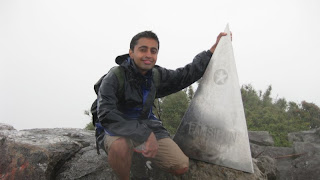
The trek was long and arduous. I'm happy I had the stamina to complete the trek in 1 day; it was a sort of personal challenge for me. It took me 12 hours to complete the trek in a continuous heavy downpour. Because this was the rainy season, there were absolutely no views at any time during my trek. However, the beautiful waterfalls and mountain streams, replenished by the heavy rains, more than compensated me for missing the views.
"It is only in adventure that some people succeed in knowing themselves - in finding themselves." -Andre Gide
The rains had picked up in intensity on my return trip. The trails were entirely submerged in water and it was getting difficult to find the way. In some places water was flowing out of the ground! Even my guide, who makes the trip here 4 times a month, had not seen so much water. The waterfalls were so pleasing to the eye and soothing to the mind.

The last 45 minutes or so of my trek before reaching the base was in complete darkness. Visibility was practically zero and I couldn't even see my own hands let alone the trail. Luckily, I had a Maglite (flash light) in my bag pack since my 22 year old guide only had the light from his Nokia cell phone to guide us. I had to cross several streams whose level had increased significantly since the morning. The current was so strong that it was difficult to keep my balance. At that point in time the only thing I had in my mind was to get back to my room, take a hot shower and sleep.
The next day (July 1st) I felt very good and felt like I had earned the right to have a large Margarita pizza for lunch. The pizza was made with fresh cheese and freshly crushed tomatoes and cooked on wood fire - it was topped with basil and a peeled tomato skin in the shape of a rose was in the center. It was the most delicious pizza I ever had. I also had the most magnificent view of the valley and mountains from my window seat in the restaurant.
After spending a few days in Sapa, I took an overnight train to Hanoi for my flight back home. Since it was an overnight train, I had booked a 2-tier A/C sleeper ticket. The four berths, two on each side, were inside a private cabin. Before entering my cabin, I saw what I thought were two pretty girls. They turned out to be lady boys! There was also a guy with them who was clearly gay. It was going to be an interesting journey indeed locked inside a cabin with two lady boys and a gay man! At first I was a bit nervous, but I was able to relax after some small talk with them.
The lady boys are different than the hijras of India in that the lady boys were born as normal males, but undergo surgeries to look like a woman. The hijras, on the other hand, are hermaphrodites.
I only had 1 day in Hanoi before taking a flight back home. So I decided to live it up on my last day and checked into a nice hotel. For the first time, I had A/C, cable TV and hot water in my room (all at the same time) - it was nice.

You can do it too!
Many people say to me that they too wish to travel like me and experience some of the greatest, wildest and strangest things this world has to offer. My reply is this: with the right motivation, you can do it too! It just depends on what your priorities are. For some it’s buying a house or a BMW, for others it’s their career, and yet for others its starting a family - for me, it was traveling (for the time being). Don't get me wrong, I'm not a new-age hippie. I do want a relatively "normal" life and make lots of money and be rich - and god willing, I will be one day! :)
From my pictures it might look like it was all fun and good times, but I had to give up, sacrifice, put on hold and risk a lot of things to make it happen. Things like my job, career, buying a house, making G's (opportunity cost)!
Now that I'm back, I have nothing to show for what I've gained and what I've become. Nevertheless, it was very rewarding in a non-tangible way.
Most people I met along the way were traveling for at least six months, and some for as long as two years. I met a newly married American couple (in their early to mid 30s) who quit their corporate jobs in Seattle, rented out their house, and went traveling for two years. I met them while trekking in Burma and they only had a few more weeks left before heading back home (to reality). People lead such interesting lives.
There aren't many things that can bring two people as close as traveling together. It can also have the opposite effect since even married people are not used to spending 24 hours together. I think traveling is the true test of compatibility between two people.
Where to next?
People often ask me where my next trip will be. At this point in time, my next trip will be to the office! I don't see myself traveling for a long stretch any time soon, but I do hope to do it again in the distant future... my dream is to see this beautiful world - it's worth seeing!
My marital status notwithstanding, I have already chosen my honeymoon destination (and a few backup ones just in case) - guaranteed not to disappoint anyone! It is one of the most exotic and beautiful places in the world and is called the "last Shangri-la". However, how much sightseeing we will get done will be another story. ha ha


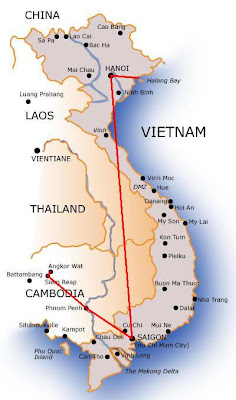
 I wanted to climb Mt. Fansipan (known as "The Roof of Indo-China") in northern Vietnam. However, that plan was dropped since I have no one to go with and climbing Vietnam's highest peak alone is definitely not a good idea. Instead, I'm now planning to go to Ha Long Bay (near Hanoi). Ha Long Bay is a UNESCO World Heritage site. The Bay features thousands of limestone isles of various shapes and sizes. From the pictures, it looks pretty cool.
